Detours and Disjunctions – On Arto Lindsay’s
occupation of Coaty
Over several days in 2013, artist/musician Arto Lindsay and a group of artists spent time together at Coaty, a nearly abandoned building in Salvador that was designed by architect Lina Bo Bardi in the late eighties. Their revival of the space included special contributions by modernist artists Tarsila do Amaral, Sonia Ebling and Maria Martins. I worked as Arto’s assistant throughout 2015 and got to know several elements of the main story related here. Other details came from other people and texts. But what exactly occurred during the time they were there, I could only get closer to by way of some detours, which is why this text starts and ends with other, related narratives.

Detail of Coaty in Salvador. Photo: Mayra Lins
The story goes that one day, a long time ago, a painting appeared on the Praça do Campo Grande in Salvador. According to some, it was a Di Cavalcanti work, while others claim that it was definitely a van Gogh. The work stood there in broad daylight for all the passersby to see, and the next day it was gone. Some people speculated that it was an action by renegade artists who had stolen the work. Others said that architect Lina Bo Bardi was behind it, though it would have been strange for the director of the Museu de Arte Moderna da Bahia to take a precious artwork out of the museum. What exactly happened was not entirely clear, except that the painting made an appearance on one of the main squares of the city that day.
When I visited Salvador in 2015, I heard a variation of this anecdote from artist/curator Lanussi Pasquali, and later on we managed to fact-check the story with architecture professor Carla Zollinger. She confirmed it with local artist Santi Scaldaferri, who was Lina Bo Bardi’s assistant at MAM Bahia in the early sixties. We found out that there were in fact two artworks displayed on the Praça do Campo Grande one day in 1960: a painting by van Gogh and another one by Renoir. They were part of the collection of the Museu de Arte de São Paulo (MASP) and were going to be displayed in one of the first exhibitions at the newly opened MAM Bahia. Carla found a magazine report on the event that describes how 30.000 children flooded the square to see the paintings, which brought “art in direct contact with the Brazilian people”. Politicians and important figures gave speeches. Placing the works in public space made them reach a crowd that no indoor exhibition would have been able to draw. It was a great publicity stunt as well as a democratising gesture, but it was also a daring and speculative act of introducing two European modern paintings to the local context, exposing them to a crowd and to the direct Bahian sunlight (something that would certainly be condemned by today’s museological standards). One of the results was that several narratives about what happened were propelled into the future and are recounted to this day.
But wait, I had actually come to Salvador to learn about an entirely different story! It also involves Lina Bo Bardi and an artwork that was temporarily dislocated from MAM Bahia: O Touro, painted by leading modernist artist Tarsila do Amaral (1886-1973). This was a more recent event, set in motion by artist and musician Arto Lindsay, though it reaches back to earlier moments in modernist history as well. To share this story, I should first tell you about the location where it all took place and where I was brought by my hosts Lanussi and her partner Joãozito Pereira.
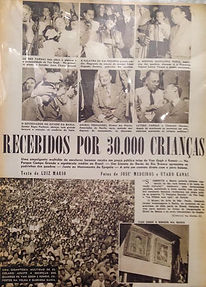
Report about MAM Bahia opening
.jpg)

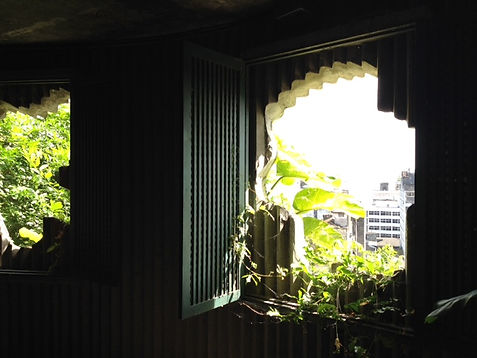
Windows and overgrown atrium at Coaty
Standing at one of the amorphously-shaped windows of the Coaty building you can look out over the lower city and the ocean from a secluded spot, tucked against the hillside and overgrown with plants. Coaty is part of the Ladeira da Misericordia, a downward sloping street whose history dates back to the sixteenth century. This is where, in 1987, architects Lina Bo Bardi and João Filgueiras Lima (‘Lelé’) realized the first phase of their renovation proposal for Salvador’s historical city centre. They insisted that the area remain part of a low-cost residential neighbourhood where inhabitants could live and work. They made gentle yet bold interventions, attempting to preserve the historical houses by bringing in pre-moulded elements, such as partition walls, buttresses and stairs made of reinforced concrete that could be assembled manually on site and used to strengthen the existing structures. The Coaty building was a new addition that was integrated with the other buildings through one unifying gesture: all the walls are corrugated in a manner reminiscent of a pleated palm-leaf. In the centre stands a mango tree, which determines the concentric layout of the space.
For many years Coaty functioned as a restaurant serving Afro-Bahian cuisine. It was abandoned around the turn of the century when the Ladeira da Misericordia was closed off, supposedly because safety measures needed to be taken to secure city hall, which is located right around the corner. When I visited in 2015, Lanussi and Joãozito explained they had obtained a key to the building and began to let a few people into the space every now and then, without calling much attention to it. I knew from Arto Lindsay that he was one of the people they had invited early on, and that he carried out an action there in 2013.
When I asked Lanussi what exactly took place with their friend Arto two years prior, she answered, “Well, there were four women whose works were somehow in obscurity…” And she told me their names: Lina Bo Bardi, Tarsila do Amaral, Sonia Ebling and Maria Martins.
_JPG.jpg)
View from Coaty

Lanussi Pasquali, Joãozito Pereira and Vanessa Soisnier at Coaty


Central space of Coaty and view from above with O Touro. Photos: Mayra Lins
This story goes as follows: over several days in 2013, Arto spent time at Coaty together with Joãozito and Lanussi, photographer Mayra Lins, actress and dancer Nivea Pitta, assistant Elialdo Batista dos Santos, and Helmut Batista, director of CAPACETE. They introduced artworks, objects and sounds to the space. They brought liveliness back to it. Arto played music, made drawings and wrote lyrics. They made silicon moulds of details from the building and placed them in the room. They also presented artworks by three female modernist artists.
One of them was Tarsila do Amaral’s painting O Touro (Boi na floresta) (The Bull (Ox in the Forest)) from 1928. The work depicts a horned bull among trees that look like vertical columns in a deep violet blue. It was created during Tarsila’s Pau Brasil and Antropofagia periods – the years when she was concerned with creating a nationalist art based on traditional and rural scenes, and was digesting European influences into a distinctive Brazilian modernist style. O Touro is known to be one of the most outstanding pieces from the MAM Bahia collection.
Looking up information about the painting, I came across newspaper articles from a few years before Arto’s occupation of Coaty, which reported that a group of locals mounted a protest against MAM Bahia. People claimed the museum was hiding O Touro from the audience. They accused the institution of maintaining “an air of mystery” around its display policy, preferring instead to present the work in exhibitions abroad, while making little effort to share the iconic piece with the residents of the city. It hadn’t been on view in Salvador in years. Perhaps these protests contributed to enabling the exceptional presence of the work at Coaty in 2013.
In addition to the long hidden O Touro, two bronze sculptures were brought to Coaty that were made by women who for many years were marginalized figures in art history: Maria Martins (1894-1973) and Sonia Ebling (1918-2006). Sonia is still the lesser known of the two. In her sculptural practice, she developed a technique of adding vegetable fibres to cement to reinforce her material. This resulted in pieces with a rough texture, somewhere in between painting and sculpture. She later preferred to cast her work in bronze and made many animal and human figures. Sonia and Maria both lived in Rio de Janeiro and knew each other well. The twenty-year older Maria took Sonia under her wing. In a text from 1959 about Sonia’s practice, Maria praised the “relentless aggression” and “rudeness” of Sonia’s works. Perhaps she yearned to find a kindred spirit in Sonia, whose work is in fact much less daring than Maria’s own.
Maria’s sculptures mixed references from nature and indigenous myths that were expressed in amorphous, corporeal and vegetable forms, sometimes bordering on the monstrous. She was a well-connected, well-travelled woman who developed a wide range of artistic interests and techniques, but she is mostly associated with Surrealism. She collaborated with the Surrealists in New York in the 1940s, but for a long time her contributions to the movement were underplayed. In Brazil the reception of her work was also slow; only in the last twenty years has she been recognized as one of the most significant female artists of the twentieth century.

O Touro by Tarsila do Amaral

O Touro by Tarsila do Amaral at Coaty. Photo: Mayra Lins

Sculpture by Maria Martins at Coaty. Photo: Mayra Lins

Nivea Pitta with sculpture by Sonia Ebling at Coaty. Photo: Mayra Lins
It is necessary to consider the past as a historical present, still alive,
and to forge another ‘true’ present.
- Lina Bo Bardi
In the short time that the small group of people spent at Coaty with these artworks, they imbued the space with new and old stories, recovering and establishing dialogues between several intersecting histories. I see their activities as a speculative act, not a clearly defined proposal, which involved some unconventional movements, such as bringing O Touro from one Lina Bo Bardi building to another. They followed the spirit of Lina’s approach to the renovations at Ladeira da Misericordia, where she introduced new elements with the purpose of strengthening existing structures. This way of working, which I think of as an architecture of support, seems to have been fundamental to many of Lina’s activities. I am reminded of the glass and concrete pedestals she designed for the display of paintings at MASP, the spiral stairway at MAM Bahia, the columns covered with laced coconut leaves at the Casa do Benin, her different chair designs – in other words, all the singular elements she designed that can support other structures, people and ideas.
Later on, in 2016, Lanussi and Joãozito occupied Coaty with permission from the municipality and ran their public programme Projeto Ativa from there for some time. The days spent there in 2013 seem to have functioned as a first reopening, a paving of the way, after which several other events could unfold.
_JPG.jpg)
Detail of Coaty

Arto Lindsay playing at Coaty, with the painting O Touro by Tarsila do Amaral in the background. Photo: Mayra Lins
There is a final story I would like to bring into relation with everything told so far: while reading about Maria Martins, I was distracted by an episode she recounts in Greater Asia and Planet China (1958), a book she wrote after a trip through that region. In the chapter ‘The Journey’, she described an incident that occurred when she took a train from Hong Kong to China. After departing from the Bay of Perfumes, not even an hour into the journey, the train stopped abruptly. Maria got off, together with the other passengers. Standing in a field by the side of the tracks, she witnessed the ultimate physical severance that a human being can suffer. A man had thrown himself in front of the locomotive. His torso was lying on one side of the tracks and his legs on the other side, the two parts no longer conjoined. With a somewhat macabre indulgence Martins described seeing “the legs without the owner, blood squirting out”. What was most shocking to her was that the other onlookers displayed no sign of emotional disturbance: “After throwing them to the same side, the legs and torso, the little train continued without a single exclamation made by anyone.”
Seeing this body splayed out like a double-page book spread may have triggered memories of a game Maria used to play with her Surrealist friends in the 1940s. This game, known as Exquisite Corpse, consists of making a collective drawing by folding a paper into segments that several people can contribute to, without knowing what the others are drawing. The pleasure of the game derives from the double act of concealing and revealing. During late nights of drinking and talking, Maria and her friends created a whole set of monstrous love-children on paper. It provided Maria with a new way of inserting the tropical myths of her home country into the minds of her friends in New York. But most of all, she enjoyed the act of splitting bodies into pieces and making them whole again, bringing together incongruous parts that a single mind could never have dreamed up to fit together.
Maria’s way of creating relationships that do not always lead to resolved, harmonious syntheses strongly resonates with Arto’s practice. His music is often created from these kinds of connected disconnections. He has the skill of holding elements together that are in disjunction, without smoothing them over, and enjoying the moment when it all breaks apart. Some of these techniques are integrated in his art practice too, and this manifested in his proposal for Coaty as well. Through an open-ended process, he created a speculative environment charged with (dis)connections, provoking new relationships and several stories.
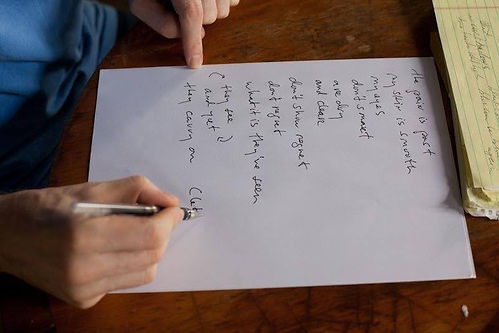

Arto Lindsay writing lyrics and a mould created from the stairway at Coaty. Photos: Mayra Lins
In memoriam Joãozito Pereira (1966-2017).